 Section 1
  Section 2
  Section 3
  Section 4
  Bibliography
 Deepening our Understanding of English Learners

A Teacher’s Guide to Building an Inclusive Classrooms
Effective support begins with understanding each student. When teachers understand how students acquire a new language, they can offer more patient, helpful, and targeted support. Linguistic and cultural diversity is not a challenge to overcome—it’s a strength that enriches our classrooms and learning communities.
“If you talk to a man in a language he understands, that goes to his head. If you talk to him in his language, that goes to his heart.” - Nelson Mandela
This quote highlights how speaking a student’s home language helps build trust and emotional connection.
“The most important single factor influencing learning is what the learner already knows. Ascertain this and teach [them] him accordingly.” - David Ausubel
This quote reminds us to start where the student is on their path to acquiring a new language and adapt our teaching accordingly.
Embracing Multilingualism

Valuing the Contributions of English Learners in Ontario Classrooms
Ontario classrooms are more diverse than ever, with English learners bringing rich languages, cultures, and life experiences. Over 200 languages are spoken in Canadian schools, reflecting the depth of our multicultural society. Rather than focusing on what students lack, we can recognize and build on the strengths they bring. Bilingualism and multilingualism support the development of problem-solving skills and an awareness of how language works. These learners help create stronger, more caring, and globally minded classrooms. Instead of asking how they can fit in, we should ask how we can create space for them to thrive.
This section explores how bilingualism enhances thinking, culture understanding, learning, and life skills—and how educators can support these strengths in everyday teaching practices.
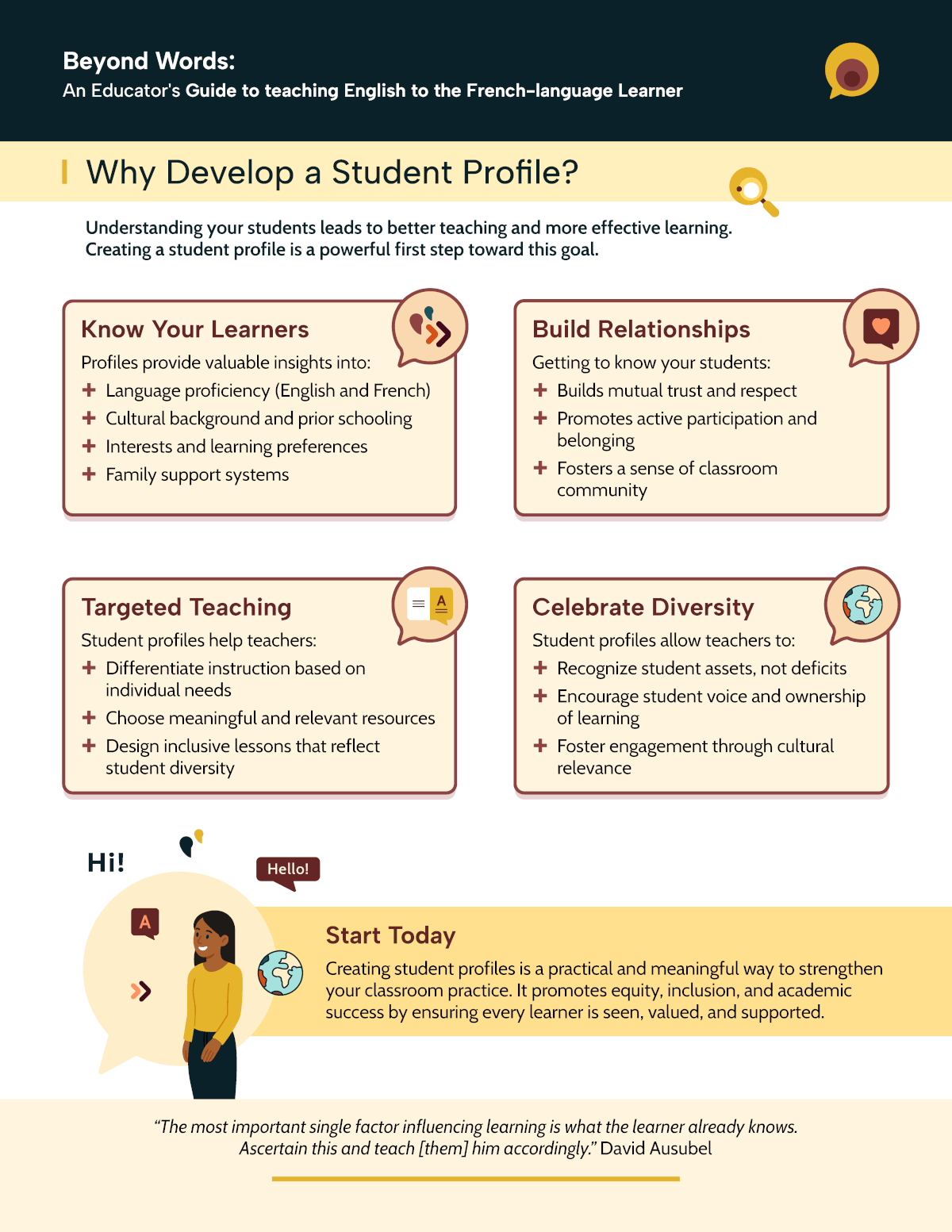
Why Develop a Student Profile?
A student profile gives teachers a clearer picture of how to support each learner. This is especially valuable for students who require additional support. It highlights students’ strengths, learning styles, interests, and areas of difficulty. With this information, teachers can plan lessons that meet students where they are and work to close learning gaps. A profile can also reveal patterns in behavior and learning—such as shifts in motivation or participation—that might otherwise be overlooked.
A student profile helps make learning more personalized, equitable, and focused on each student’s needs — creating a more inclusive classroom. It also serves as a valuable tool for planning accommodations or modifications for students with diverse learning needs. The profile provides insights into how to differentiate instruction and assessments in ways that best support each learner. In addition, it fosters stronger relationships and communication with families by demonstrating that the teacher values and understands each student’s unique background. It also helps in-school teams work more efficiently by offering clear, shared information.
Referred to: Learning for All
Charted Reflection Tool
This charted reflection tool helps educators gain a deeper understanding of the cultural and linguistic diversity within their classroom. By responding to the provided questions, teachers create a personalized chart that visually summarizes the backgrounds of their English learners. This reflection supports the development of inclusive teaching strategies and culturally responsive pedagogy.
Reflection Form
By gathering key information—such as language proficiency, cultural identity, and learning preferences—it enables responsive instruction, inclusive planning, and a stronger connection between students’ strengths and classroom instruction.
Infographic including questionnaires for the parents and for the teachers of English learners
Suggestions for Teaching Practices Based on Questionnaire Responses

- If students report diverse home languages:
Incorporate multilingual visuals and labels for each language spoken by students in the class. Encourage the use of home languages for brainstorming, note-taking, or reflection activities. - If students identify learning through visuals or hands-on activities:
Integrate graphic organizers, real-life simulations, and manipulatives to support comprehension and engagement. - If cultural traditions are noted:
Include celebrations, readings, or classroom projects that reflect and honor students’ cultural backgrounds. - If students note limited English use outside school:
Pair students with language buddies and increase opportunities for informal conversation and interactive speaking activities in class. - If learning challenges are disclosed:
Consult with the school support team to develop appropriate strategies, accommodations, or modifications tailored to the student’s needs.